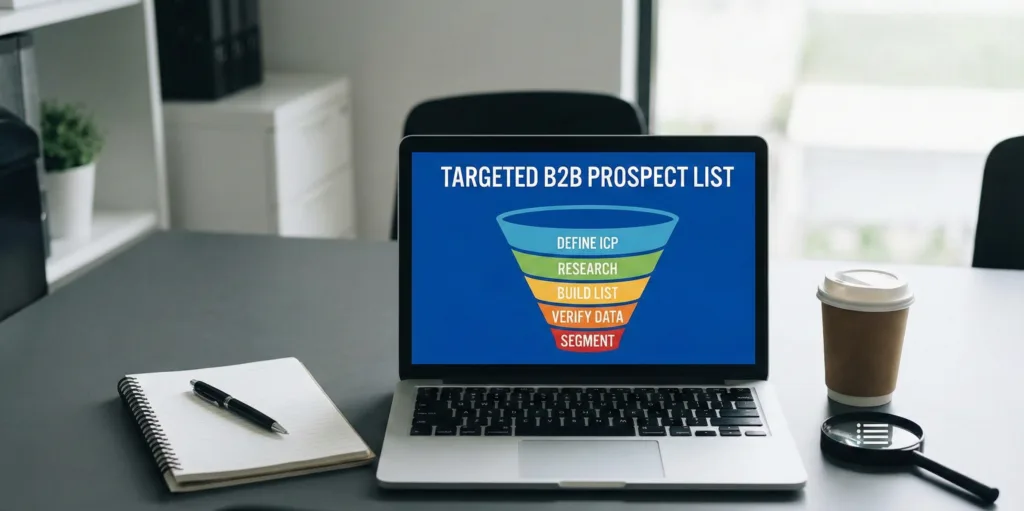
A targeted prospect list B2B teams can rely on is rarely the result of one tool or one data source. Most teams struggle because the outreach list is built without a clear ideal customer profile, inconsistent lead qualification criteria, and incomplete firmographic data. The result is wasted outreach and messy CRM records.
How to Build a Targeted B2B Prospect List: Step-by-Step Guide gives a practical workflow for founders, sales teams, growth marketers, agencies, and recruiters who need a repeatable way to scale prospect research. Web scraping can make the process scalable, but only when the data sources, fields, and quality controls are defined upfront.
For a broader view of how managed lead delivery fits into a pipeline, review the proven business leads from a compliant scraping service.
Key takeaways
- A strong ICP definition reduces list size while improving fit.
- A targeted prospect list needs consistent lead qualification criteria and field standards.
- Web scraping supports scalable prospect research when the workflow includes cleaning and validation.
- Compliance and ethical collection practices protect brand reputation and reduce risk.
What web scraping means for B2B lead generation
Web scraping is the automated collection of publicly available web data into structured rows and columns. In a B2B lead generation context, web scraping turns scattered company and contact details from directories, vendor pages, and websites into a consistent dataset. A structured dataset can be filtered, enriched, and delivered in CRM-ready formats.
Types of B2B data collected through web scraping
A targeted prospect list B2B teams can use usually combines multiple data layers. Define the required fields before extraction to reduce rework later.
Company data
- Company name and website domain
- Headquarters city, state, and country
- Industry category and keywords from public descriptions
- Public directory profile links for traceability
- Company size indicators listed on public profiles
Decision-maker and contact data
- Decision-maker name and job title (when publicly listed)
- Department or function mapping (HR, IT, marketing, procurement)
- Team or leadership page URLs for verification
- Contact page URLs and role bios (when available)
Firmographic and technographic attributes
- Firmographic data: employee count range, revenue range, funding stage, office locations
- Ownership type: private, public, subsidiary
- Growth signals: hiring pages, expansion announcements, new locations
- Technographic attributes: CMS, analytics tools, email provider, marketing automation tools
Step-by-step: build a targeted prospect list B2B teams can use
The following workflow mirrors how professional teams build lists that hold up in real outreach. For a deeper overview of managed delivery, see generating proven business leads through professional scraping.
Step 1: Write an ICP definition that is easy to apply
Start with a one-page ICP definition. The one-page ICP definition should be measurable, not aspirational.
Include:
- Industries to include and industries to exclude
- Geography (countries, states, or metro areas)
- Company size band (employee range is usually easiest)
- Buying triggers (recent funding, rapid hiring, technology changes)
Example: “US-based B2B SaaS companies with 50 to 500 employees that are hiring sales roles.”
Step 2: Convert the ICP definition into lead qualification criteria
Lead qualification criteria make list building consistent across people and campaigns.
Define:
- Target role families (example: Head of People, HR Director, VP Sales)
- Seniority levels that count as decision-makers
- Disqualifiers (student groups, personal blogs, agencies if selling to end buyers)
- Minimum required fields to keep a record (example: domain + industry + role)
Step 3: Choose data sources that match the target market
Good sources match the ICP definition and provide enough coverage to reach scale.
Common sources:
- Industry directories and association member lists
- Conference exhibitor and sponsor lists
- Vendor partner directories and reseller pages
- Local business registries and curated niche lists
- Company websites with leadership or team pages
A source list should include a short note explaining why each source matches the ICP definition.
Step 4: Define the exact fields and the delivery format
A field plan prevents “data for the sake of data.” Keep fields tied to segmentation and routing.
Recommended minimum fields:
- Company name, domain, and source URL
- Industry category and location
- Employee range or other firmographic data needed for segmentation
- Decision-maker name and title (when available)
- Validation status and last-checked date
Delivery formats that reduce friction:
- CSV with standardized headers for CRM import
- Spreadsheet with filters and a clean title taxonomy
- CRM mapping file for automated uploads
Step 5: Extract data with a compliant scraping workflow
A compliant scraping workflow focuses on public pages, controlled request rates, and auditability.
Operational practices that improve outcomes:
- Target stable page patterns and consistent listings
- Store the source URL for every record
- Use respectful request rates to reduce load on target sites
- Treat robots.txt as a signal for responsible collection boundaries
Many teams prefer a managed service to reduce engineering overhead and keep the workflow consistent. The guide on compliant scraping for proven business leads explains how professional delivery typically handles extraction and formatting.
Step 6: Clean and standardize the dataset
Raw scraped records often include duplicates, inconsistent naming, and partial fields. Cleaning makes the dataset usable.
Core cleaning steps:
- Deduplicate by normalized domain (not only by company name)
- Standardize industries into a controlled list
- Normalize locations into consistent city and state fields
- Split full names into first name and last name fields when possible
- Remove records that fail lead qualification criteria
Step 7: Validate and enrich for accuracy and segmentation
Validation improves trust. Enrichment improves targeting.
Common validation and enrichment actions:
- Confirm domains resolve and normalize website URLs
- Map job titles to role families (example: “Head of Talent” to “HR Leadership”)
- Add missing firmographic data needed for filtering
- Append a last-verified date to support freshness tracking
A targeted prospect list B2B teams reuse should include a refresh plan. A refresh plan is often monthly in fast-moving markets and quarterly in stable markets.
Step 8: Deliver outreach-ready lead formats
A delivery-ready list should be usable without manual fixes.
Include:
- A standardized file format (CSV or spreadsheet)
- Clear definitions for fields and allowed values
- Notes for missing fields (blank vs unknown vs not applicable)
- Source URLs and dates to support spot checks
How do you define an ideal customer profile for B2B?
An ideal customer profile is a written definition of the company type that is most likely to buy and succeed with the offer. A useful ICP definition includes industry, location, company size, and buying triggers. A measurable ICP definition prevents broad prospect research and reduces time spent on low-fit accounts.
What firmographic data is most useful for prospect research?
The most useful firmographic data supports segmentation and lead qualification criteria. Employee count, location, and industry narrow the market quickly, while revenue range and funding stage help estimate budget and maturity. Hiring signals and expansion indicators add prioritization context, especially when sales outreach capacity is limited.
How do you validate scraped B2B leads before outreach?
You validate scraped B2B leads by confirming company identity, role relevance, and freshness before messaging. A practical process includes deduplication by domain, title normalization against lead qualification criteria, and spot-checking a sample of source URLs. Add last-verified dates, then remove records missing required fields like domain and industry.
What is the difference between a lead list and a prospect list?
A lead list is a broad collection of potential contacts with unknown fit. A prospect list is filtered against an ICP definition and lead qualification criteria, often with firmographic data that supports segmentation. A targeted prospect list is designed for immediate routing, campaign setup, and reliable performance tracking.
Is web scraping legal for building B2B lead lists?
Web scraping legality depends on the source terms, the type of data collected, and the intended use. Public company data is often lower risk than personal data, but privacy laws like GDPR and CCPA can apply to personal data processing. A responsible approach documents sources, minimizes collection, and follows ethical boundaries.
Real-world scenarios that benefit from targeted B2B prospecting
Sales teams
- Build account lists by industry and employee range
- Identify relevant decision-makers for outbound campaigns
- Prioritize accounts using firmographic data and growth signals
Marketing agencies
- Build niche account lists for ABM and paid targeting
- Refresh prospect lists to keep targeting accurate
- Segment lists by industry and company maturity for messaging tests
Recruiters
- Identify target employers by hiring pages and growth signals
- Segment by location and company stage for role-specific outreach
- Build decision-maker lists for HR leadership outreach
SaaS and B2B service providers
- Target accounts using technographic attributes when relevant
- Identify partners and resellers through vendor directories
- Scale prospect research without expanding headcount
Data quality, compliance, and trust considerations
Accuracy and freshness
- Prefer sources with recent updates and visible timestamps when available
- Keep source URLs and extraction dates for every record
- Track last-verified dates to support refresh cycles
GDPR, CCPA, and FTC awareness
- GDPR and CCPA are privacy frameworks that may apply to personal data processing
- FTC guidance emphasizes truthful marketing claims and responsible data handling
- Documentation of sources, purpose, and retention supports internal governance
This section is informational and not legal advice.
Ethical scraping boundaries
- Avoid bypassing access controls or collecting gated content without permission
- Use respectful request rates to reduce disruption to target sites
- Treat robots.txt as a meaningful boundary signal where applicable
- Collect only the fields needed for lead qualification criteria
Common mistakes and misconceptions about scraping B2B leads
- Building lists before writing an ICP definition
- Treating volume as a proxy for quality
- Using inconsistent title rules across campaigns
- Skipping deduplication by domain
- Ignoring list decay and delaying refresh cycles
- Collecting unnecessary personal data fields without a clear purpose
Best practices checklist for How to Build a Targeted B2B Prospect List: Step-by-Step Guide
- Write a one-page ICP definition with measurable constraints.
- Translate the ICP definition into lead qualification criteria with explicit disqualifiers.
- Choose sources that match the ICP definition and have reliable coverage.
- Define required fields and the delivery format before extraction.
- Store a source URL and extraction date for every record.
- Deduplicate by normalized domain, not only by company name.
- Standardize industries, locations, and job titles using controlled lists.
- Validate role relevance against the lead qualification criteria.
- Enrich with firmographic data to support segmentation and routing.
- Track last-verified dates and set a refresh cadence.
FAQ
Q: What should be included in a targeted B2B prospect list file?
A: A targeted B2B prospect list file should include company name, domain, industry, location, firmographic data needed for filtering, decision-maker name and title when available, source URL, and last-verified date.
Q: How large should a first prospect list be for an outbound test?
A: A first outbound test list is often 200 to 1,000 prospects, sized to support segment testing without exceeding outreach capacity.
Q: How do you choose lead qualification criteria for outbound campaigns?
A: Lead qualification criteria should match the sales motion and pricing model, typically using industry, location, employee count, target role family, and clear disqualifiers.
Q: How often should a targeted B2B prospect list be refreshed?
A: A targeted B2B prospect list should be refreshed monthly in fast-changing markets and at least quarterly in stable markets, because job titles and company status change frequently.
Q: When should a team use a managed scraping service instead of building in-house?
A: A team should consider a managed scraping service when engineering time is limited, data sources require ongoing maintenance, or compliance and quality controls need consistent enforcement.
Conclusion
A repeatable pipeline starts with a measurable ICP definition, consistent lead qualification criteria, and disciplined prospect research. How to Build a Targeted B2B Prospect List: Step-by-Step Guide works best when web scraping is paired with cleaning, validation, and enrichment so the final list is usable, current, and traceable. For a full view of compliant lead delivery for scalable growth, read the article on proven business leads from a powerful scraping service and consider a managed approach when safety and scale matter.
Leave a Reply