Email Verification & Data Quality: Ensuring Accurate Business Leads is less about tools and more about avoiding preventable waste. A single bad list can burn hours, frustrate reps, and quietly damage deliverability. The fix is not complicated, but it does require a few consistent checks before leads ever touch a sending platform.
Accurate lists come from two habits: verifying emails and keeping lead data clean enough to segment, route, and report on. When those habits are in place, bounce rate reduction becomes easier and lead scraping accuracy becomes more predictable.
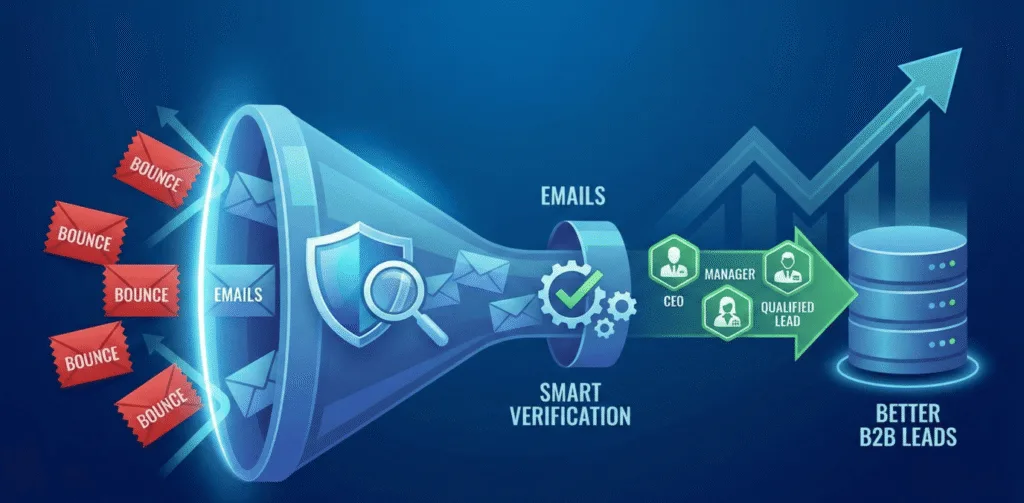
If your team is evaluating different ways to source contacts at scale, the broader overview in Get Proven Business Leads from a Powerful Scraping Service explains how professional scraping fits into an end-to-end lead workflow.
Why accurate lead data matters before sending the first email
Most outbound teams notice data quality only after something goes wrong. A campaign launches, bounce rates spike, or reps complain about duplicates. By that point, cleanup is slower and more expensive.
Low-quality data usually shows up as:
- Hard bounces that pull down inbox placement over time
- Duplicate contacts that distort pipeline reporting
- Contacts tied to the wrong company domain
- Job titles that no longer match the real decision-maker
- Extra manual work in spreadsheets and CRMs
Better data validation reduces all of these issues. The biggest benefit is simple: the team spends more time talking to prospects and less time fixing lists.
What email verification really does in a B2B lead process
Email verification is a set of checks that estimate whether an address can receive mail. Email verification does not guarantee a person will reply, and email verification is not the same as “confirmed interest.” The point is bounce prevention and cleaner list handling.
Most contact verification workflows include:
- Syntax checks to catch obvious formatting errors
- Domain checks to confirm the domain exists and can receive mail (DNS and MX records)
- Mailbox-level signals that indicate whether the inbox is likely to accept messages
- Risk flags for disposable emails, role inboxes (info@), and known high-risk patterns
Verification is most useful when teams label results and act on them. Treat “verified” differently from “catch-all” and “unknown.”
Data validation rules that keep lead lists usable
Email verification is only one part of list quality. A verified address is still a messy lead if the company field is wrong or the record is duplicated five times.
A practical data validation checklist looks like this:
- Clean name fields (trim spaces, remove odd characters, standardize casing)
- Normalize company names and confirm the website domain matches the company
- Standardize location fields so targeting rules work (country, state, city)
- Use consistent job title categories for routing (Sales, Marketing, IT, Operations)
- Deduplicate using email, domain, and unique profile URLs when available
- Fill required fields before export (email, company, domain, role category)
These steps are not glamorous, but they make every downstream tool work better, including CRMs, sequencers, and analytics.
For teams sourcing at scale, the lead source matters because it determines how much cleanup happens later. The guide on getting compliant, structured business leads through scraping covers what to look for in a lead delivery process.
Bounce rate reduction tactics that teams can apply immediately
Bounce rate reduction starts before the send. Teams that wait until a campaign is live are always reacting.
Useful habits that reduce bounces:
- Verify emails before importing any list into an outreach platform
- Create segments based on verification status (verified vs. catch-all vs. unknown)
- Suppress addresses that previously hard bounced, even if they appear again later
- Avoid sending large volumes to new domains without warm-up and pacing
- Keep a “do not send” list that combines bounces, complaints, and unsubscribes
Segmentation is the practical lever. When higher-risk contacts are separated, teams can test carefully without risking the whole domain.
Email authentication and why it affects perceived list quality
Email authentication is not email verification, but teams often mix them up. Email authentication helps mailbox providers trust the sender. If authentication is missing or misconfigured, even a clean list can underperform because messages get filtered.
Email authentication typically includes:
- SPF to authorize sending sources
- DKIM to sign messages
- DMARC to set policy and reporting
When deliverability suddenly drops, many teams blame “bad leads.” Sometimes the real cause is the sending setup. Authentication and clean data work together.
People Also Ask: What is email verification in B2B lead generation?
Email verification in B2B lead generation is a technical check that identifies whether an email address is valid and likely to accept messages. Email verification typically includes syntax validation, domain and MX record checks, and mailbox-level risk signals. Email verification helps reduce hard bounces and supports cleaner list segmentation.
People Also Ask: How does contact verification improve lead scraping accuracy?
Contact verification improves lead scraping accuracy by filtering out invalid emails and flagging higher-risk addresses before outreach. Contact verification also helps teams standardize records, reduce duplicates, and keep lists consistent across tools. The result is fewer bounces and more reliable segmentation based on verified contact fields.
People Also Ask: What causes high bounce rates in cold B2B email campaigns?
High bounce rates in cold B2B email campaigns usually come from invalid addresses, outdated records, job changes, and domain issues. Catch-all domains and role inboxes can also increase uncertainty. Pre-send verification, deduplication, and a suppression process for hard bounces are the most direct ways to reduce bounce rates.
People Also Ask: Are catch-all domains safe to email in outbound?
Catch-all domains are not automatically unsafe, but catch-all behavior increases uncertainty because many addresses appear deliverable even when the mailbox does not exist. Catch-all results are best handled as a separate segment. Smaller test sends and tighter targeting reduce risk when emailing catch-all domains.
People Also Ask: How often should a B2B team revalidate a lead list?
A B2B team should revalidate a lead list regularly because inboxes and roles change over time. Many teams revalidate monthly for active outreach lists and quarterly for longer-term databases. Revalidation usually includes email checks, deduplication, and updates to company and role fields to maintain accuracy.
A simple workflow for Email Verification & Data Quality: Ensuring Accurate Business Leads
A workable process is one that a team can repeat every time a new list arrives.
- Source leads with consistent fields so cleanup does not become a weekly project.
- Verify emails and label results (verified, catch-all, unknown, invalid).
- Validate core fields like company domain, location, and role category.
- Deduplicate records using email and domain, plus profile URLs where possible.
- Segment leads by risk and relevance before uploading to outreach tools.
- Track outcomes and update suppression lists based on bounces and complaints.
For teams that want to scale without turning list management into full-time work, sourcing and delivery matter. The overview in Get Proven Business Leads from a Powerful Scraping Service explains the broader lead generation approach.
FAQ: email verification and data quality for B2B leads
Q: Does email verification guarantee deliverability?
A: No. Email verification reduces the chance of hard bounces, but deliverability also depends on sending reputation, email authentication, and campaign volume.
Q: Should a team delete role-based emails like info@?
A: Not always. Role inboxes can work in some industries, but response rates are often lower and ownership is unclear. Many teams keep role inboxes in a separate segment.
Q: Can a verified email become invalid later?
A: Yes. Inbox status can change when a person leaves a company, an address is disabled, or the domain changes configuration. Regular revalidation and suppression of hard bounces help keep lists current.
Q: What is the best order before importing leads into a CRM?
A: Verify emails first, then validate and standardize fields, then deduplicate, then import. This order reduces duplicates and prevents messy records from spreading across the CRM.
Conclusion
Email Verification & Data Quality: Ensuring Accurate Business Leads is what keeps outbound stable as volume grows. Verification lowers avoidable bounces, data validation keeps records usable, and segmentation reduces risk. For scalable growth, professional scraping paired with quality controls is the safest approach. For the full sourcing workflow, read Get Proven Business Leads from a Powerful Scraping Service.
Leave a Reply