Understanding GDPR & Data Privacy Compliance in Lead Scraping
Here is your article, formatted with strong bolding for SEO and readability, with headers structured correctly and your internal link added at the end.
Understanding GDPR & Data Privacy Compliance in B2B Lead Scraping
In the case of B2B founders, sales groups, and agencies, the pipeline has to be filled at all times. As much as web scraping is an effective solution to automate the lead generation process, it is often a silent killer of legal ambiguity. Can you scrape data legally? What is the relevance of GDPR on publicly available business information?
The compliance of data privacy and GDPR in scraping leads is no longer a matter of choice, but an essential operational need. The process of prospecting manually cannot be scaled, and purchasing cold lists usually leads to low conversion. The answer is compliant web scraping: a systematic, transparent method of gleaning public B2B information that does not interfere with privacy legislation but provides the quantity of information your business requires.
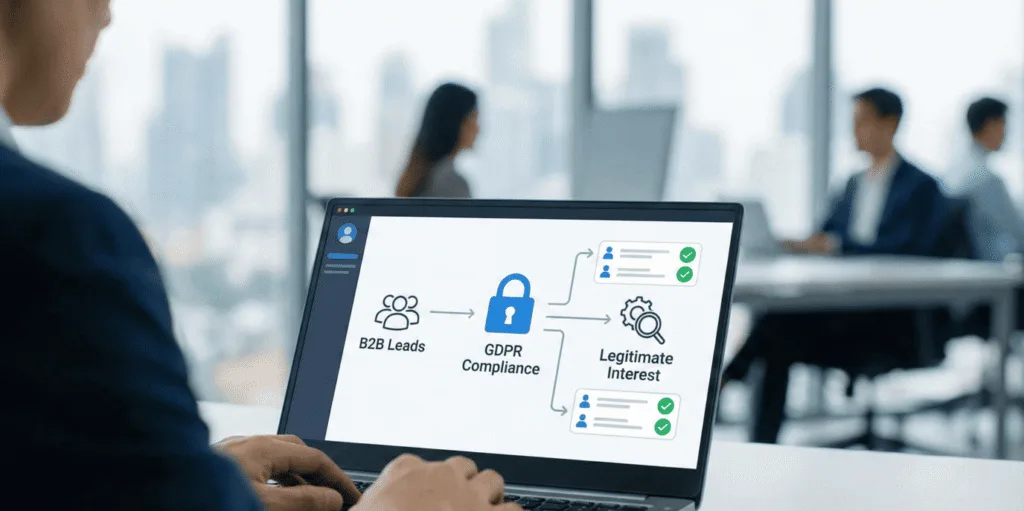
This guide explains why professional scraping services are useful in assisting organizations to create quality business leads without incurring regulatory penalties or damaged reputations.
Web Scraping and Data Privacy Intersection
B2B Web scraping entails an automated process of collecting publicly accessible business data on websites, directories, and social networks. Nevertheless, the fact that data is public does not imply that it is not regulated.
The General Data Protection Regulation (GDPR) radically altered the manner in which organizations have to deal with personal data. In B2B, personal data is any kind of information related to the identification of a person, including a professional email address (e.g., john.doe@company.com) or direct phone number.
In order to scrape ethically, companies should stop their “grab everything” approach and use a privacy-first approach. This implies that it is necessary to distinguish between corporate and personal data (the latter must have a lawful foundation to be processed).
Which Data Should Be Scraped at All?
Effective and safe scraping campaigns are centered around three different types of data:
- Firmographic Data: These are firm-level attributes such as the legal entity names, headquarters location, industry groupings, and revenue estimates. This information is hardly safeguarded by GDPR because it does not identify people.
- Technographic Data: With advanced scraping tools, it is possible to determine what software stack a company operates (e.g., Salesforce, HubSpot, or Shopify). It cannot be underestimated by SaaS firms seeking the users of rival or complementary technologies.
- Professional Contact Data: This entails names, job titles, and business emails. This is the most sensitive category. Under GDPR, you need to inform yourself of having a “Legitimate Interest” in collecting this data as well as ensuring that you are merely collecting the bare minimum.
The Framework of Legitimate Interest
Among the largest myths of B2B marketing is that you should always seek permission (opt-in) in order to handle the data. According to GDPR, there are six legal justifications for data processing. In cold outreach and lead scraping, the Legitimate Interest is the most cited.
To be able to use Legitimate Interest, your scraping strategy will have to be tested on three parts:
- Purpose: Do you have a valid business interest (e.g., business growth)?
- Necessity: Does scraping get you this? (i.e., you cannot get the same effect by less obtrusive means).
- Balancing: Are the rights of the person more important than your interest? (e.g., scraping personal home addresses would not pass this test, however, scraping the Business LinkedIn profile of a CEO likely would).
> Caution: The information is strategic, not legal. Always seek advice on your jurisdiction.
Best Practices of Scraping B2B Compliantly
Legal rules (GDPR/CCPA) and technical rules of websites have to be respected in order to create a sustainable lead generation engine.
Respect Robots.txt and Server Load
Technical politeness begins with ethical scraping. The robots.txt file is a collection of directions on a site that tell crawlers what one site should allow them to see. Compliant scrapers respect these rules. Besides, they manage the request rates such that they never overwhelm the server of a target site, so they appear to be a human browser rather than a bot.
Practice Data Minimization
Don’t peel data which is not necessary. In case you are aiming to locate decision-makers in the fintech industry, there is no reason to scrape their personal social media photos or the history of their homes. One of the fundamental principles of GDPR is data minimization—gathering information that is required to serve your particular need.
Data Accuracy and Right to be Forgotten
Scraped data has a shelf life. Not only is old data useless in making sales, but it is also a liability. You need mechanisms for cleaning and validating data on a regular basis. Moreover, in case a prospect requests to be taken off your database, you should consider this request and comply with it on the spot and forever.
What are the Benefits of Professional Scraping?
The creation of internal scraping infrastructure is expensive and dangerous. The maintenance of proxies, dealings with CAPTCHAs, and the need to adapt to evolving web designs are time-consuming to the engineering team.
More to the point, the services of professional scrapers serve as a buffer to compliance. They are privacy-by-design, which means that they are designed to ensure:
- Validation of data sources.
- Automatic opt-outs processing.
- Delivery of structured and clean data (CSV, JSON) that can be easily integrated with CRMs.
Outsourcing this complicated job allows agencies and sales teams to work on closing deals and not on the legal risk.
(FAQ)
Is it legal to scrape LinkedIn profiles? Public data scraping is usually regarded as legal in most jurisdictions, as long as you do not circumvent a login wall or otherwise break terms of service which make a breach of contract. Nonetheless, the processing of such data (storing and using it) must be done with strict compliance to GDPR.
Are non-EU companies subject to GDPR? Yes. When you are scraping the data of EU citizens, then GDPR imposes itself on you irrespective of the location of your business headquarters.
How is CCPA and GDPR different on scraping? GDPR (Europe) demands a legal justification prior to the gathering of data. CCPA (California) does not prohibit data collection in general; however, it enables consumers to learn what was collected and gives them the right to opt-out of the sale of their data.
Conclusion
Lead generation does not exclude data privacy. As a matter of fact, compliance enhances the quality of leads. Given that you only touch the public data that is pertinent and comply with the privacy limits, you end up with an accurate, fresh, and high-converting prospect list.
To those organizations willing to go large with their outreach, the way is obvious: they should dump manual research and dangerous bulk lists. Instead, take advantage of open, professional scraping processes.
Are you willing to create a stable stream of quality leads? Our guide covers the steps to follow to extract data safely: Get Proven Business Leads with a Powerful Scraping Service.very.
Leave a Reply