Scraped lead lists often contain duplicate records. Duplicate records waste sales time, inflate list size, and create messy reporting. Lead database deduplication is the process of finding the same company or contact across multiple rows, then deciding which record to keep and how to merge the best details.
For teams that rely on scraping for scalable prospecting, lead deduplication database cleaning is part of basic data hygiene. A clean list improves deliverability, reduces repeated outreach, and makes lead management systems easier to trust.
When teams build pipelines from scraped sources, cleaning should sit alongside compliance checks and validation. The most dependable workflows pair list building with structured quality assurance, similar to the approach described in the pillar guide on getting proven business leads from a powerful scraping service.
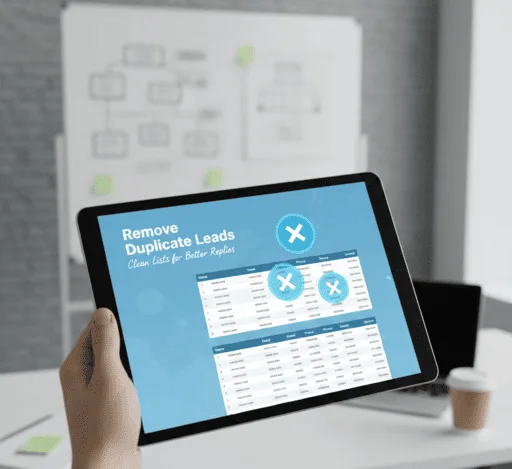
Lead database deduplication workflow for cleaning scraped lead lists
Lead Database Deduplication: Cleaning Your Scraped Lead Lists works best as a repeatable workflow. A repeatable workflow prevents last-minute spreadsheet fixes and reduces mistakes.
A practical process has five stages:
- Standardize fields before matching (data normalization)
- Generate match keys (exact and fuzzy)
- Run duplicate detection (rules plus scoring)
- Merge records (contact merging rules)
- Lock in prevention controls (lead management guardrails)
Teams that treat deduplication as a quality gate often see faster handoff from list building to outreach. The article on compliant, scalable lead sourcing explains why consistent quality steps matter for long-term growth.
Data normalization steps that reduce duplicates before matching
Duplicate detection fails when fields are messy. Data normalization reduces noise so matching becomes more accurate.
Key normalization actions:
- Company names: Remove legal suffixes where helpful (Inc, LLC, Ltd), standardize punctuation, and trim extra spaces.
- Domains: Convert to lowercase, remove tracking parameters, and normalize www usage.
- Phone numbers: Convert to E.164 format when possible, or at least standardize country codes and separators.
- Emails: Lowercase and trim. Consider removing “plus addressing” parts when appropriate for matching.
- Addresses: Standardize abbreviations (St vs Street), split into fields (street, city, state, postal code).
- Job titles: Normalize seniority and role terms (VP Sales vs Vice President of Sales) for reporting, not for identity matching.
Normalization is not only a cleanup step. Normalization is a quality assurance control that reduces both false positives and false negatives in deduplication.
Duplicate detection methods that work for scraped data
Most teams need more than one matching method. Scraped datasets often include partial records, inconsistent formatting, and missing identifiers.
Exact matching using strong identifiers
Exact matching works when a field is highly unique.
Common exact match keys:
- Primary email address
- Company domain
- Full URL to a profile page, if stable
- External business ID, if available
Exact matching is fast and low-risk, but exact matching can miss duplicates when data sources differ.
Fuzzy matching for near-duplicates
it compares similarity rather than perfect equality. Fuzzy matching is useful for company names, addresses, and person names.
Common fuzzy approaches:
- String similarity for company names
- Token matching for long names (for example, “The Acme Group” vs “Acme Group”)
- Address proximity matching using standardized address fields
- Phone number partial matching when formatting varies
Fuzzy matching needs thresholds. Set conservative thresholds first, then review samples and adjust.
Tools like OpenRefine for clustering and near-duplicate detection can help review fuzzy matches before contact merging.
Rule-based scoring for practical contact merging
A scoring model combines multiple signals. The model helps decide whether two records represent the same lead.
Example scoring signals:
- Same domain (high weight)
- Similar company name (medium weight)
- Same phone number (medium weight)
- Similar address (medium weight)
- Same contact last name plus same domain (medium weight)
The scoring approach supports scalable lead management because it reduces manual review while still allowing human checks for edge cases.
People Also Ask: What is lead database deduplication for scraped lead lists?
Lead database deduplication for scraped lead lists is the process of identifying repeated company or contact records and consolidating them into a single, accurate entry. The goal is to keep one best version of each lead with the strongest identifiers and most complete fields. The result is a cleaner list for outreach and reporting.
People Also Ask: How do you find duplicates when emails are missing?
You can find duplicates without emails by combining other identifiers into match keys. Use company domain, phone number, address fields, and company name similarity to run duplicate detection. A scoring approach helps confirm matches when no single field is unique. Manual review of high-risk matches prevents incorrect merges.
People Also Ask: What is the safest way to merge duplicate leads?
The safest way to merge duplicate leads is to define clear contact merging rules before you combine records. Keep a “master” record, then copy only verified fields from secondary records. Preserve source metadata and timestamps to track provenance. Test merging on a small sample first to avoid large-scale errors.
People Also Ask: Why do duplicates hurt outbound performance?
Duplicates hurt outbound performance because repeated outreach can trigger spam complaints, reduce reply rates, and damage brand trust. Duplicates also inflate funnel metrics and make conversion reporting unreliable. Clean lead deduplication database cleaning improves deliverability and helps sales teams focus on new opportunities instead of repeated targets.
People Also Ask: How often should lead lists be deduplicated?
Lead lists should be deduplicated every time new scraped data is added to a working database. Weekly or daily deduplication is common for high-volume teams. The correct frequency depends on list velocity and outreach cadence. Regular deduplication protects lead management accuracy and reduces repeated prospecting.
Contact merging rules for B2B lead management teams
Contact merging is where mistakes become expensive. A good merging policy makes outcomes consistent.
Practical contact merging rules:
- Choose a master record: Prefer the record with the strongest unique identifiers, such as email plus domain.
- Prioritize the freshest data: Keep the most recent job title, company size, or location if dates are known.
- Do not overwrite validated fields: If one record has a verified email or verified phone, keep it.
- Merge multi-value fields carefully: Store multiple phone numbers or emails as separate values only if the CRM allows it.
- Keep source attribution: Save source URL, scrape date, and collection method for auditing and quality assurance.
- Log merges: Keep a merge log for rollback and troubleshooting.
These rules make deduplication consistent across teams and reduce the risk of merging two different companies with similar names.
Deduplication in spreadsheets vs CRM vs data warehouse
The right tool depends on volume and team maturity.
- Spreadsheets: Useful for small lists, but fragile for ongoing operations. Spreadsheet deduplication often relies on exact matches and manual filters.
- CRM dedupe features: Good for ongoing lead management, but CRM rules can be limited and hard to audit. CRMs may not handle fuzzy matching well.
- Data warehouse or database: Best for scale. Databases support repeatable pipelines, match scoring, and better logging.
Teams that use scraping as a serious growth channel often move beyond spreadsheets. The guide on reliable lead sourcing explains why scalable workflows matter for quality and compliance.
Quality assurance checks after deduplication
Deduplication should end with verification steps. Quality assurance reduces the chance that duplicates remain or that correct records were merged incorrectly.
Recommended checks:
- Sample review: Inspect a random set of merged records and a set of rejected pairs.
- Collision check: Look for one email linked to multiple company domains.
- Coverage check: Track how many records lost emails or phones during merges.
- Field completeness: Measure the percent of leads with required fields after cleaning.
- Outreach readiness: Confirm that each lead has enough data for personalized outreach.
These checks create a feedback loop so matching thresholds and rules improve over time.
FAQ
Q: What is the difference between deduplication and data normalization? A: Deduplication removes repeated leads by identifying matches and consolidating records. Data normalization standardizes formatting and field structure so matching and reporting become more accurate.
Q: Should you deduplicate before or after email verification? A: Deduplicate before email verification in most workflows. Deduplicating first reduces the number of emails to verify and prevents paying to verify the same address multiple times.
Q: What fields are best for duplicate detection in B2B leads? A: Email address and company domain are the strongest identifiers. Phone number and standardized address fields help when emails are missing. Company name similarity supports fuzzy matching but should not be used alone.
Q: How do you avoid merging two different companies with similar names? A: Require at least one strong identifier match, such as domain or phone, before merging. Use conservative fuzzy thresholds and route ambiguous pairs to manual review.
Q: Can a scraping service deliver deduplicated leads? A: Yes. A professional scraping service can apply lead deduplication database cleaning steps, including normalization, duplicate detection, and merge rules, before delivering a lead file.
Conclusion
Lead Database Deduplication: Cleaning Your Scraped Lead Lists protects outreach performance and reporting accuracy. Deduplication and data hygiene turn scraped data into a usable lead asset instead of a noisy spreadsheet.
For scalable growth, reliable scraping plus consistent cleaning is the safest approach. Review the full framework in the guide on getting proven business leads from a powerful scraping service.
Leave a Reply